


Scientifically proven protection against limescale
Scientifically Proven: How the Calconditioner Works
The Calconditioner’s effectiveness is based on a physical principle that is also recognized in science: altering the structure of lime particles (calcium carbonate) using electric or electromagnetic fields. As a result, lime particles are less likely to adhere to surfaces such as heating elements, pipes, or taps.

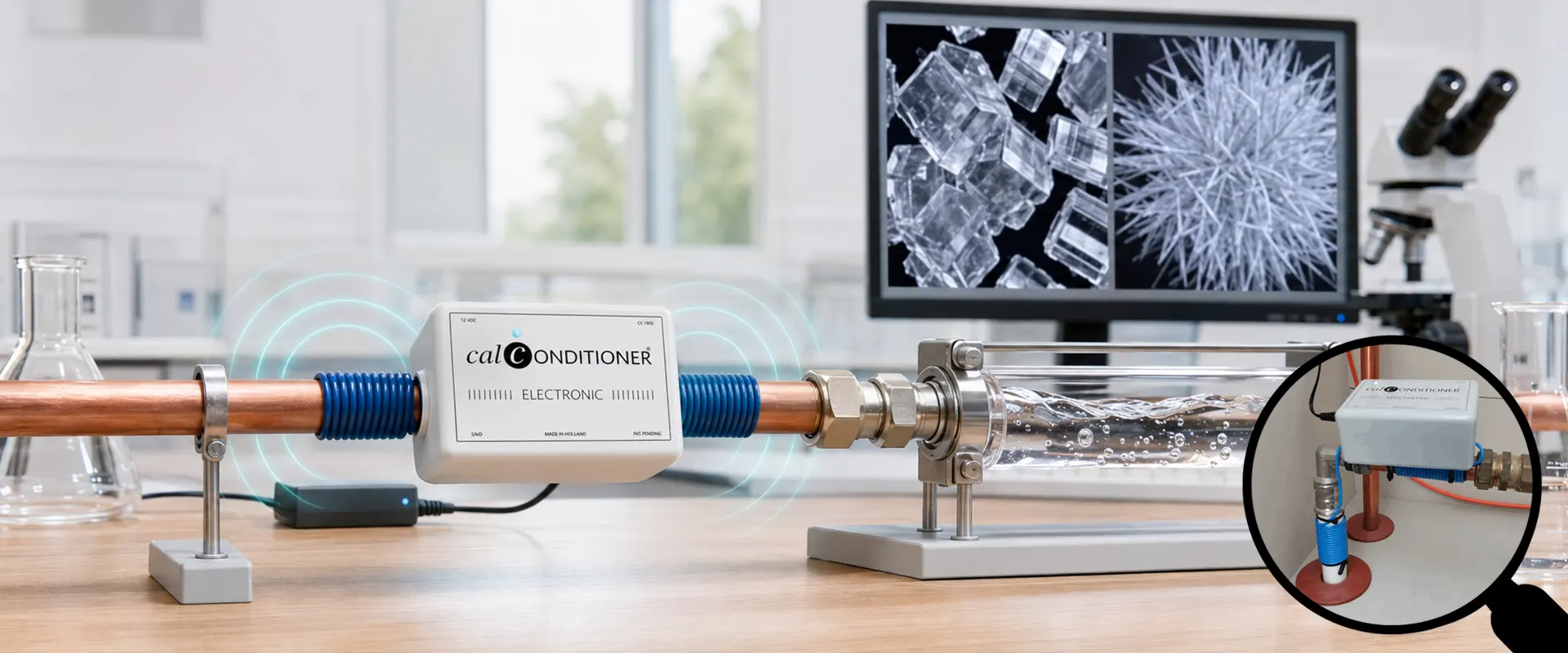
The Calconditioner changes the crystal structure of limescale.
This makes the difference between stubborn scale buildup and easily rinsed particles.
Left: Without Calconditioner – large, angular limescale crystals (calcite) stick to surfaces.
Right: With Calconditioner – small, rounded crystals (aragonite) remain suspended in the water and do not adhere.
Scientific Support
1. Change in Crystal Structure
Research published in the journal Water Research demonstrated that electromagnetic water treatment
alters the crystal structure of calcium carbonate. This process encourages the formation of softer, less adhesive crystals like
aragonite instead of the hard calcite form. These softer crystals are more easily carried away by the water flow.
📚 Source: Parsons et al., Water Research, 1997
2. Reduced Limescale on Heat Exchangers
A study by the Laboratoire de Chimie Physique (CNRS / Université Paris-Sud) found that electromagnetic fields
significantly reduce limescale deposits on metal surfaces. Instead of sticking, the lime particles remain suspended
in the water and can be flushed out easily.
📚 Source: Coey & Cass, Journal of Magnetism and Magnetic Materials, 2000
3. Influence on Nucleation and Crystal Growth
Researchers from the University of Bath concluded that weak electromagnetic fields slow down limescale formation
by interfering with the nucleation process (the initial phase of crystal formation). This leads to smaller and less adhesive particles.
📚 Source: Baker & Judd, Proceedings of the 6th World Congress on Desalination and Water Reuse, 1993
In Practice
These scientific findings form the foundation of how the Calconditioner works. In practical terms, this means:
- Less limescale in appliances and pipes
- Reduced energy loss due to insulating limescale layers
- Longer lifespan for devices such as boilers, kettles, and washing machines
Published Studies
Would you like to learn more about how a Physical Anti-Scale Device (PASD) works and explore the scientific principles behind this technology? Below you will find a selection of scientific publications, research reports, and patents concerning the influence of electromagnetic fields on the formation of limescale deposits.
These studies focus on topics such as changes in crystal formation, the adhesion of scale deposits, and the reduction of limescale on heating surfaces and inside pipework. Several publications have been made publicly available and can be downloaded free of charge as PDF documents.
Would you like to learn more about the practical application of this technology? On the page How the Calconditioner Works, we explain the principle in more detail. All models available in our online shop operate according to this principle. The Calconditioner is not a permanent magnet but a Physical Anti-Scale Device (PASD).
Patents
Patent 192956 — Device for Preventing Scale Deposits
Source: Benelux Patent Platform (RVO)
Scientific Literature
Electromagnetic Fields for the Treatments of Wastewater
Authors: Ali Yadollahpour / Samaneh Rashidi
Describes the application of electromagnetic fields in water treatment and precipitation processes.
Application of Electromagnetic Fields for Scaling Control
Authors: Lu Lin / Wenbin Jiang
Investigates the influence of electromagnetic fields on scale control and crystal formation.
Effects of Electromagnetic Treatment of Hot Water
Authors: Takuya Okazaki / Senshin Umeki
Examines the effects of electromagnetic treatment of hot water on limescale formation.
Operation of Physical Anti-Scale Devices
Author: Dr. G. IJpelaar
Discusses the operation and scientific background of physical anti-scale equipment.
Vorzüge der magnetischen Wasserbehandlung
Author: Dr. Klaus J. Kronenberg
Report on the effects and applications of magnetic water treatment.
Has the Mystery of Magnetic Water Treatment Been Solved?
Author: Dr. J. Kronenberg
Analysis of the possible mechanisms behind magnetic water treatment.
Launch of Scientific Research into Physical Anti-Scale Devices in the Netherlands
Author: Ing. E. During
Overview of the first research initiatives into physical water treatment in the Netherlands.
Magnets Do Affect Limescale… and It Can Be Measured
Author: Ir. Arjen Dijkgraaf
Practical research into measurable effects of magnetic treatment on scale deposits.
Anti-scale Magnetic Treatment
Authors: J.S. Baker / S.A. Parsons
Research into the influence of magnetic treatment on the formation of scale deposits.
Magnetic Treatment – Scale Effect – pH Control
Authors: S.A. Parsons / B.L. Wang / S.J. Judd / T. Stephenson
Studies the relationship between magnetic treatment, pH levels and scale formation.
Mitigation of Heat Exchanger Scaling by Magnetic Treatment Devices
Authors: D.I. Wilson / S.A. Parsons
Investigates the reduction of scale deposits in heat exchangers through physical water treatment.
The Effect of Magnetic Fields on the Precipitation of Calcium Carbonate
Authors: R. A-Barrett / S.A. Parsons / P. Hillis / P.P. Coetzee
Research into the influence of magnetic fields on the precipitation of calcium carbonate.
125 Years of Physical Water Treatment
Authors: Dr. Dietman Ende / M. Anders
Historical overview of 125 years of research into physical water treatment.
Evaluation of the Principles of Magnetic Water Treatment
Author: American Petroleum Institute
Evaluation of the theoretical principles behind magnetic water treatment.
Influence of Magnetic Treatment on Solubility of Calcium Sulphate
Authors: P.S. Chechel / G.V. Annenkova
Investigates the influence of magnetic treatment on the solubility of calcium sulphate.
Magnetic Treatment of Fluids — Preventing Scale
Author: J.D. Donaldson
Discusses how magnetic treatment may contribute to reducing scale deposits in fluid systems.