


How the Calconditioner
Electronic Descaler works
How does an electronic descaler work?
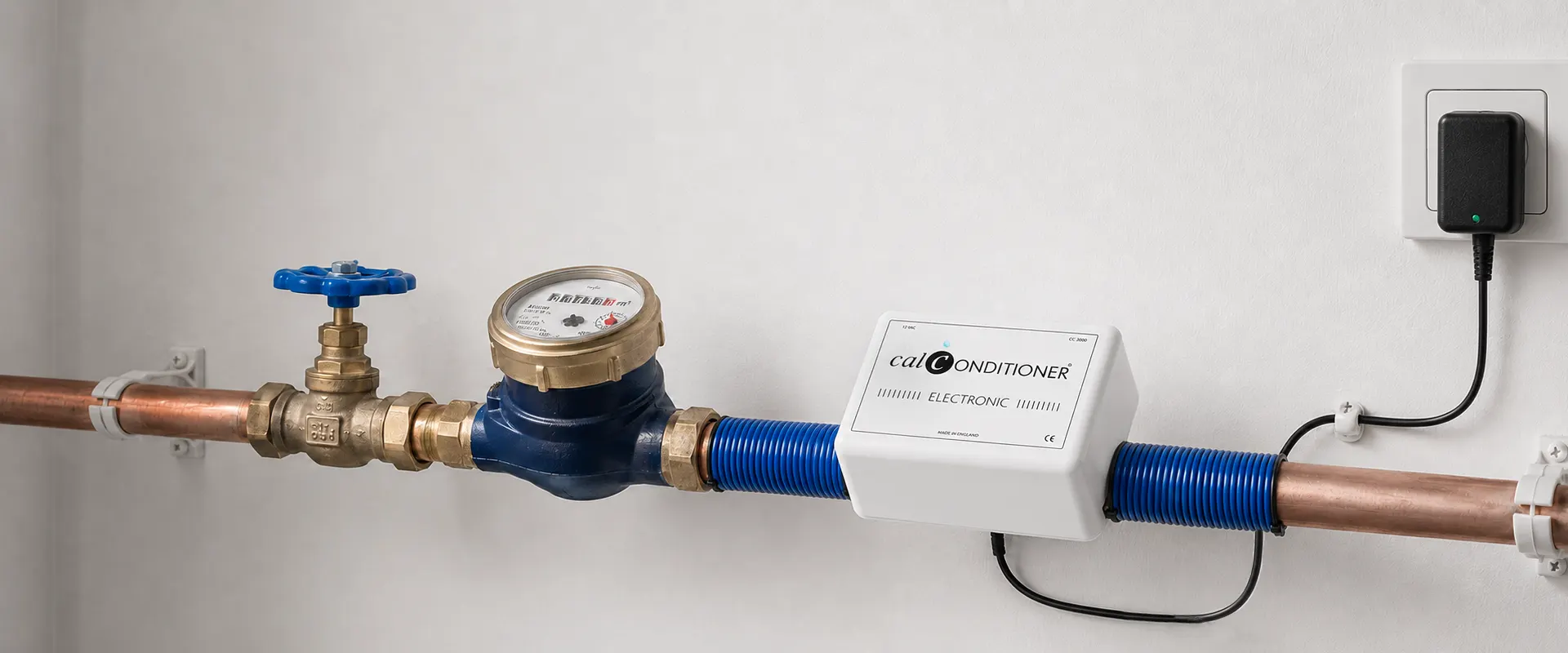
Would you like to know more about how the Calconditioner works? We’re happy to explain! To understand how the Calconditioner works, it’s important to know how limescale or scale actually forms. That’s why we’ll first explain what causes this problem. This will give you a better picture of how the Calconditioner protects your home from limescale.
An electronic descaler is not a water softener
There’s a persistent misunderstanding about water softeners and electronic descalers, which are often marketed interchangeably online. Let’s clear that up. It’s simply impossible to electronically remove the limescale particles present in water — that requires a water softener, with a costly filtration installation. What the Calconditioner actually does is temporarily change the properties of the limescale particles, so that they clump together in a different way. As a result, they no longer stick to pipes, but flow away with the water as a fine powder. This keeps your water pipes clean and prevents annoying limescale buildup. With the Calconditioner electronic descaler, you enjoy all the benefits of soft water, without having to invest in a costly filtration installation. Calconditioner is an active electro-physical electronic descaler.
The minerals in tap water
Tap water contains various minerals that determine how “hard” the water is. These minerals are often grouped together under the name “limescale,” but in reality they are several different substances. Hard water mainly contains calcium bicarbonate (Ca(HCO₃)₂), which consists of calcium (Ca²⁺), dissolved carbon dioxide (CO₂), bicarbonate (HCO₃⁻) and carbonate (CO₃²⁻).
Limescale can in principle form at any water temperature, but formation increases sharply from around 40°C — the warmer the water, the faster limescale is deposited. The reason is simple: as water heats up, dissolved carbon dioxide escapes from it. This causes calcium and carbonate ions to combine into stable nanoclusters of around 70 ions — something that already happens in highly diluted water. As the concentration rises further, these nanoclusters grow together into larger aggregates and eventually crystallise into calcium carbonate (CaCO₃). Which crystal form results depends on the water’s pH: under weakly basic conditions, stable calcite forms, while under more strongly basic conditions, unstable vaterite forms. This mechanism was first observed in real time by researchers at the Max Planck Institute of Colloids and Interfaces.
With the Calconditioner, you no longer need to worry about limescale in your water pipes and appliances. Through the Calconditioner’s electronic method, the minerals take on different properties, so they no longer stick to pipes and appliances. This way, you enjoy soft water and save on costly repairs.
If you’d like to know more about how limescale crystals form, take a look at the Max Planck Institute’s press release on the subject.
Most of the calcium carbonate that forms is carried away again with the water, but some always remains behind. This remaining portion builds up as a layer of limescale and scale in appliances, particularly on their heating elements. The insulating effect of this limescale layer prevents heat transfer in an appliance. This means that considerably more energy is needed to generate heat. Limescale therefore leads to a higher energy bill. It’s precisely this remaining layer, which blocks heat transfer, that the Calconditioner tackles.
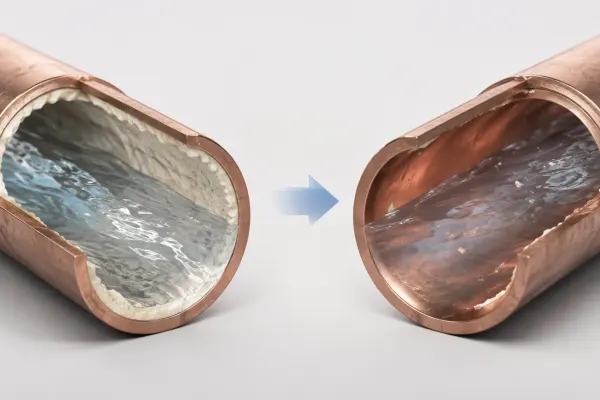
Calconditioner also removes existing limescale. Old limescale breaks down layer by layer. Limescale particles that may settle during a long period when the water isn’t flowing disappear quickly again as soon as the water starts moving. That’s why Calconditioner is also a good solution for boilers or hot water tanks.
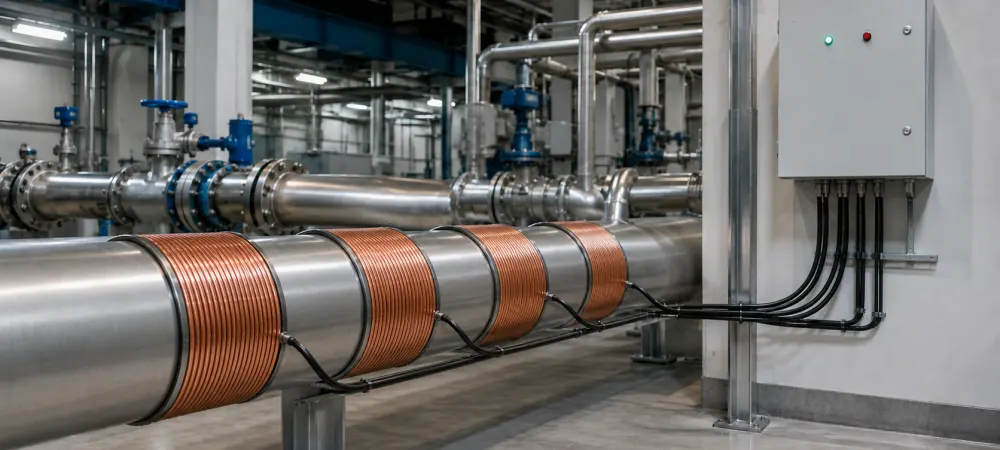
In industry, this principle is widely applied, precisely because it’s cost-effective and maintenance-free.
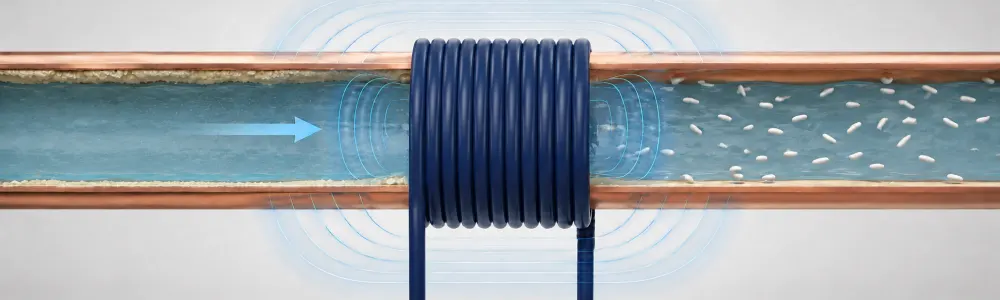
The Calconditioner electronic descaler neutralises the charge difference, so that limescale particles no longer attract one another. As a result, the particles no longer stick to pipes and heating elements. They stay suspended in the water and leave the pipes without forming limescale deposits. Existing limescale deposits are also gradually dissolved through this process, as the “treated” water flows past them. After around 70 hours, the limescale particles regain their original charge, but by that point the water has long since disappeared down the drain. So when water comes out of the tap or showerhead, these limescale particles are still in a state where they don’t form deposits. This means limescale buildup on the shower wall, floor, countertop or sink is considerably reduced. If any residue does remain due to rapid evaporation, it can easily be removed with a cloth or a brush.
Frequently asked questions
Is the effect proven?
Yes. Several studies have looked at the effectiveness of electro-physical electronic descalers, and the principle is already widely applied in industry, precisely because it proves itself in practice, is cost-effective and requires no maintenance. As with most water treatment technologies, some studies reach differing conclusions — you can read more on our page about the scientific background.
What are the benefits of an electronic descaler?
It prevents limescale, saves energy, gives your skin a more pleasant feeling after showering, and extends the lifespan of appliances such as boilers and washing machines.
Where can I buy an electronic descaler?
Our electronic descalers can be ordered easily online through this website. We deliver quickly and with clear installation instructions.