



Frequently asked questions
Where does the lime go?
Calconditioner doesn’t remove lime particles from the water but temporarily alters their structure, rendering them harmless. This innovative technology prevents the particles from adhering to surfaces or clumping together. As a result, it effectively stops lime deposits while retaining essential and healthy minerals like calcium and magnesium.
Is there scientific proof of how Calconditioner works?
Yes, there is scientific evidence supporting how Calconditioner works. The Calconditioner was launched in the 1990s. During that time, many studies were conducted, such as the one published in the leading scientific journal Nature, Effects of Electromagnetic Treatment of Hot Water, and a report by TNO was also released. Calconditioner is a patented product – click here to view this patent.
Is the use of Calconditioner deemed safe for my health and the environment?
Yes, Calconditioner is very safe. Calconditioner changes the state of the limestone particles in your water pipes, which causes the limestone to keep flowing instead of attaching to your pipes and heating elements. The way the particle state changes is a natural process and is as such healthy for you and friendly to the environment. Calconditioner removes and prevents limescale but also ensures healthy minerals will remain in your pipes, which have a direct influence on your health. A lack of calcium and magnesium can be detrimental to your well-being.
What is the power consumption of a Calconditioner?
The Calconditioner models CC750, CC1500 and CC2500 consume approximately 2.5 kilowatt-hours per year.
How can Calconditioner be so much less expensive than other brands?
Calconditioner costs only €169.00, while the prices of other brands can be up to €1,800.00. This price difference arises because Calconditioner uses a simpler, maintenance-free method to prevent limescale. The buyer can also easily install the device themselves. Other brands use a different technique that is far more expensive: filtering the water.
How does Calconditioner differ from expensive devices?
Limescale can be fought in multiple ways. All limestone can be filtered from the water or the limestone can be altered so it does not need to be filtered. Calconditioner does the latter. While filtering water can be beneficial in certain cases, such as preventing skin conditions or for production processes, it is generally more expensive due to higher installation and maintenance costs.
Is a Calconditioner friendly to the environment?
Yes, the Calconditioner electronic descaler is friendly to the environment. A Calconditioner electronic descaler uses only a very small amount of electricity, which saves you a lot of power and gas usage on your appliances. This is friendly to both your wallet and the environment. By using a Calconditioner electronic descaler you will use up to thirty percent less soap products. Soap is a lot more efficient in soft water. Perhaps most importantly, with Calconditioner, there’s no need for harmful chemical water softeners. These are very harmful to the environment.
The pH values have remained the same. Doesn’t that mean the water is still hard?
Calconditioner doesn’t remove lime from your water like a filtration system would; instead, it prevents the lime from sticking to surfaces, which in turn keeps your appliances and pipes clean on the inside and also lowers power consumption. Limestone will keep flowing through your pipes, so when measuring you will not see a decrease in pH values.
Is using Calconditioner safe for my health?
Yes, Calconditioner electronic descaler is healthier than other water softeners. Calconditioner doesn’t remove limestone and minerals from your pipes, but ensures they will not attach to your pipes and appliances. The composition of your water remains the same. Some devices use salt and resin, which change calcium ions to sodium ions — this can be harmful for individuals with kidney issues, heart failure, or high blood pressure.
Can Calconditioner be used on plastic pipes?
Yes, Calconditioner can be used on all kinds of pipes (copper, plastic, aluminum and steel). We advise against using Calconditioner on older buildings with lead pipes. In such cases, limescale can act as a protective layer, preventing lead from dissolving into the water. Using lead pipes in buildings was banned in: Belgium in 1970 – Germany in 1973 – United Kingdom in 1970 – France in 1995 – The Netherlands in 1960.
For countries not listed here please inform yourself of the composition of your pipes before purchasing Calconditioner
Why does my coffee taste better with Calconditioner?
Calconditioner removes the limescale on the heating elements of your coffee maker. With clean heating elements, your coffee maker performs better, heating the water more efficiently, resulting in hotter coffee. Your coffee will start tasting like you are using a new coffee maker.
Why is there still limescale in my kettle?
Limescale can still appear if water sits in your kettle for extended periods. Calconditioner prevents limescale buildup by altering the state of the lime particles in your water pipes, keeping them from sticking to surfaces. However, if water remains stagnant in your kettle, the particles can begin to reattach over time. Despite this, you’ll find that any limescale that does form is much easier to remove than before—a simple scrub will be sufficient. This applies to all your appliances as well.
Shortly after installing Calconditioner my faucet was clogged, how is this possible?
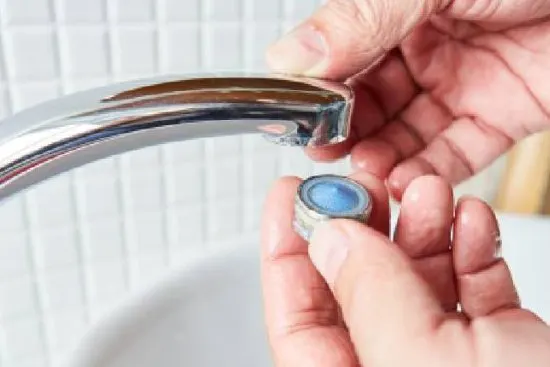
Calconditioner doesn’t just prevent new limescale in your pipes and appliances, existing limescale will come loose as well. The existing limescale often turns into a fine powder which flows down the drain with the water. If there is a lot of existing limescale that comes loose this may cause clumps which are too large to fit through your faucet. This is easily resolved by detaching and cleaning the faucet filter (as demonstrated in the image).